China Property Signals (#35): Secondary Home Market Overtakes The Primary
About this Newsletter: Get a quick but more granular view of (still) one of the most important sectors in China, with the weekly chart and commentary from Real Estate Foresight (REF) - drawing on 14+ years of REF's research on China housing markets.
In July, China’s Ministry of Housing and Urban-Rural Development (MoHURD) highlighted that the housing market is entering an era increasingly dominated by secondary transactions.
In the first half of 2026, secondary-market transaction volumes accounted for 50.4% of total housing transactions, up from 46% in 2025, a significant milestone. In 18 provincial markets, including Beijing, Shanghai, Jiangsu and Guangdong, the secondary home transactions exceeded those in the primary market.
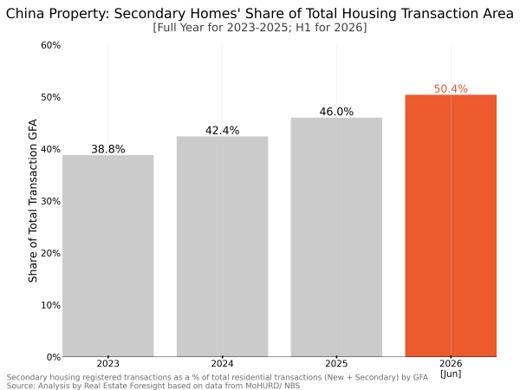
It's not just the drop in the primary market that makes the secondary take a larger share. The secondary-market transaction volume increased by 10.2% y/y for H1 2026 (according to MoHURD).
At Real Estate Foresight Limited (REF), we have been highlighting this structural shift for several years. China’s housing market is gradually moving away from a model centred overwhelmingly on developers, new construction and primary sales towards one in which existing homes, urban renewal, and management of the established housing stock play a much larger role.
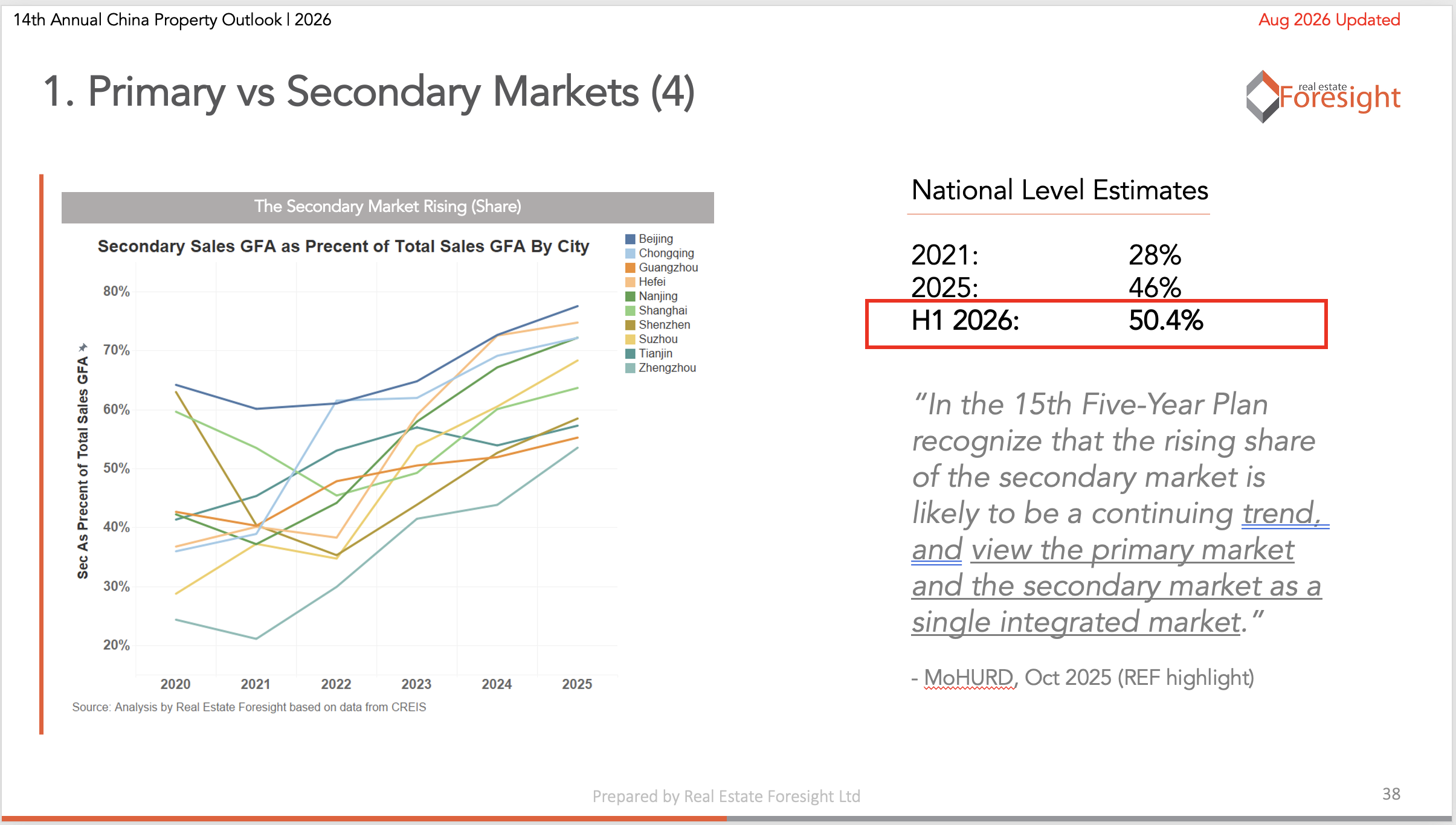
This also affects the interpretation of headline property indicators.
It's interesting to read how MoHURD frames this (translated):
"The decline in indicators such as new starts and new home sales should be viewed objectively. As local governments actively introduce policies aimed at controlling new supply, reducing inventory, and improving supply quality, the drop in real estate development metrics reflects both the implementation of the central government’s strict requirement to curb excess supply and the market’s rapid move toward a more balanced supply-demand relationship."
The transition is far from straightforward or complete, and it will differ substantially by city. And the Politburo July meeting again emphasised the need to "stabilise the real estate market" (in the context of financial stability and security), as the macro-property indicators have been mostly deteriorating in 2026 at the national level.
The following quote (MoHURD) from October 2025 also captures the new framing of the 'housing market':
“In the 15th Five-Year Plan, recognise that the rising share of the secondary market is likely to be a continuing trend, and view the primary market and the secondary market as a single integrated market.”