China Property Signals (#27): About Those Tiers | Tier-1 vs National Sales
About this Newsletter: Get a quick but more granular view of (still) one of the most important sectors in China, with the weekly chart and commentary from Real Estate Foresight (REF) - drawing on 14+ years of REF's research on China housing markets.
What happens in the housing markets in Tier-1 cities in mainland China represents only a small part of the overall housing market at the national level. But what is that percentage?
There are around 700 cities in China, among which over 100 have an urban population of above 1 million people. The common 'by tier' classification highlights Beijing, Shanghai, Shenzhen, and Guangzhou as the four Tier-1, then the regional centres form 36 Tier-2, with the rest in the broader Tier-3 and Lower-Tier category.
The observable universe of cities with reasonably frequent, consistent, and accessible housing market data is quite small relative to the overall number.
One of the most important and widely watched national indicators is new home sales, published by the National Bureau of Statistics (NBS). But NBS does not release comparable figures at the city level (it used to do so some years ago - see further below).
Using the bottom-up data from CREIS (China Index Academy) for 112 cities (including all Tier-1 and most of Tier-2), we calculated that for 2025, Tier-1 cities' new home sales represented around 10% of the new home sales in 112 cities.
Comparing the same bottom-up figure for Tier-1 to NBS national data indicates around 3%-4% 'share'.
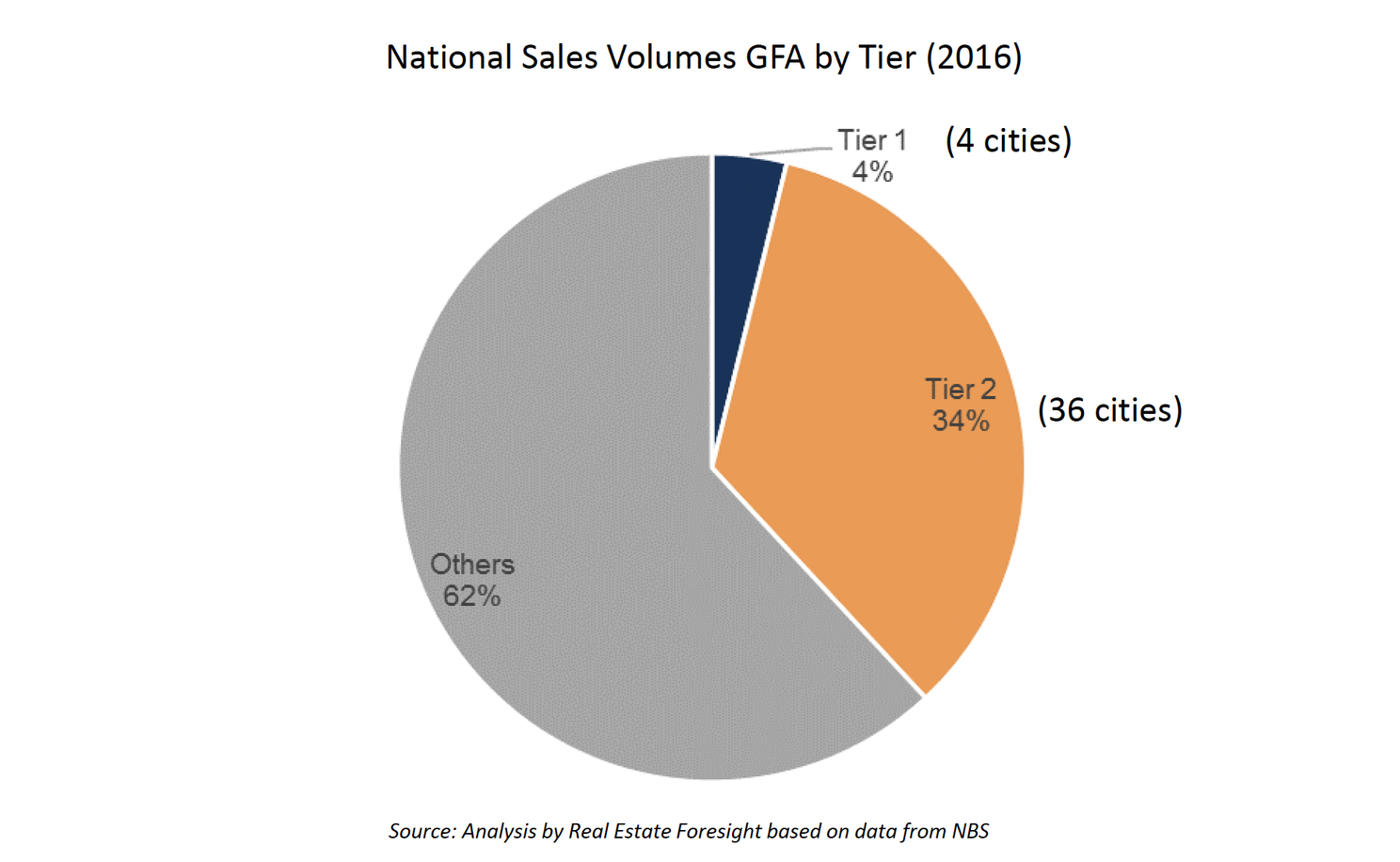
Several years ago, when we did have comparable Tier-1 and national NBS figures, our estimate was that Tier-1 cities made up around 4%-5% of the national sales, with a similar percentage for other metrics such as land sales.
The implication is that when you next read about 'China housing', but you see the data presented refers to Tier-1 cities, you can assume that the sample you read about is only around 3-5% of the total.
Some 10 years ago (yes, we do keep the archives!), we had this chart in one of the presentations: